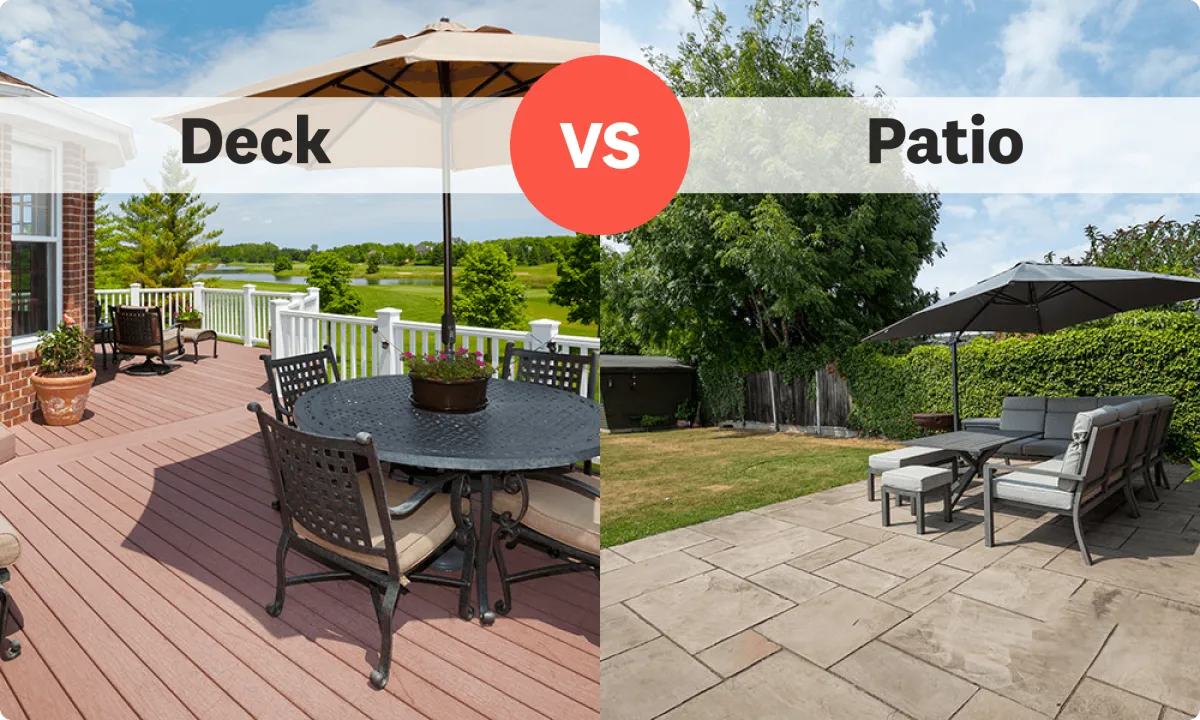
Deck vs. Patio Massachusetts | Which Is Right for Your Backyard?
Should I build a deck or a patio in Massachusetts? The single most decisive factor is terrain — if your yard slopes more than 18–24 inches from the back door, a deck is almost always the right choice. Patios are better for flat yards, tighter budgets, and fire pit integration. Composite decks cost $14,000–$24,000 for 400 square feet and recoup 65–75% at resale. Paver patios run $6,000–$10,000 for the same footprint. The highest-value option for most Central Massachusetts properties is a combined composite deck and paver patio with a fire pit. Horizon Deck and Patio builds both throughout Lunenburg, Northborough, Westborough, Southborough, and Hopkinton.
Deck vs. Patio: Which Is the Better Choice for a Massachusetts Backyard?
It is one of the first decisions Massachusetts homeowners face when planning an outdoor living project: should you build a deck or a patio?
Both transform your backyard. Both add usable living space and meaningful value to your home. But they work differently, cost differently, and suit different yards, budgets, and lifestyles. The right answer depends entirely on your specific situation — and there is no universal winner.
Tyler Grams at Horizon Deck and Patio has helped homeowners across Lunenburg, Northborough, Westborough, Southborough, and Hopkinton work through this exact question. This guide gives you the honest framework for making that decision — including the specific factors that matter most in Central Massachusetts.
What Is the Difference Between a Deck and a Patio?
A deck is an elevated or ground-level platform structure, typically framed with pressure-treated lumber and surfaced with wood or composite decking boards. Decks are usually attached to the house. Because they are elevated structures, decks require footings below the frost line and building permits in Massachusetts.
A patio is a ground-level outdoor surface installed directly on or in the ground — typically using concrete pavers, natural stone, brick, or poured concrete. Patios do not have a framed substructure. They sit on a prepared base of gravel and compacted sand. In most cases, standard ground-level patios do not require permits in Massachusetts, though this varies by town and project scope.
Both can include fire pits, seating walls, outdoor lighting, and covered features. Both can be beautifully designed and professionally installed. The differences come down to terrain, budget, intended use, and long-term maintenance.
When a Deck Makes More Sense
Your yard has a slope or grade change
This is the single most decisive factor in the deck-vs-patio decision for Massachusetts homeowners. If your yard slopes away from the house — which is common in Central Massachusetts given the region's varied terrain — a deck is almost always the more practical and cost-effective solution.
Building a patio on a sloped yard requires either significant excavation and grading (expensive), a retaining wall system (also expensive), or accepting a patio surface that sits below the level of the house's back door (which creates drainage problems and an awkward indoor-outdoor flow). A deck solves all of this elegantly. The framed substructure bridges the grade change and puts your outdoor living surface at door height.
Rule of thumb: if your yard drops more than 18–24 inches from the back door to where you want the outdoor surface, a deck is almost certainly the better call.
You want seamless indoor-outdoor flow at door height
Elevated decks create a seamless transition from the house to the outdoor space — step out the back door and you are on the deck at the same level. Ground-level patios require stairs or a ramp to access from most back doors, which interrupts that flow. If you want your outdoor dining table to feel like an extension of your kitchen rather than a separate destination in the yard, a deck delivers that experience far better than a patio.
You want to maximize views
In wooded New England yards — which describes most properties in Lunenburg, Northborough, and Hopkinton — a deck raised even 3–4 feet above grade lifts you above the shrubs and ground-level vegetation, opening up the yard view considerably. A ground-level patio puts you in the landscape rather than above it.
You are optimizing for resale value
In Massachusetts's real estate market, composite deck additions consistently recoup a strong percentage of project cost at resale — typically in the range of 65–75% for well-built composite decks. Buyers in the $500,000–$1,000,000 price range that dominates Northborough, Westborough, and Southborough actively look for outdoor living features, and a quality composite deck reads as a premium upgrade that wood decking or a basic patio cannot match.
When a Patio Makes More Sense
Your yard is flat
If your backyard is essentially flat from back door to lawn, a patio can be the cleaner and more cost-effective option. There is no need to engineer a framed structure over level ground. The patio surface installs at the same grade as the existing yard, which also eliminates the railing and stair requirements that add cost to elevated decks.
You want the lowest long-term maintenance outdoor surface
Properly installed paver patios are extraordinarily low-maintenance. High-quality concrete pavers are resistant to cracking, freeze-thaw cycling, and surface degradation. Individual pavers can be replaced if they ever shift or crack without disturbing the rest of the surface. There is no wood to rot, no boards to replace, no composite to clean. Natural stone patios offer similar durability with a distinctive aesthetic that suits New England properties particularly well.
A fire pit is a priority
Fire pits are one of the most popular additions to outdoor living spaces in Massachusetts — and they extend your outdoor season significantly. Paver patios and fire pit seating areas are a natural pairing. A fire pit set flush into a paver patio surface looks architecturally intentional and clean. The same fire pit on a wood deck raises safety and insurance concerns. On a composite deck, an in-ground fire pit is not recommended at all. If a fire pit is a must-have for your project, a patio or a deck-and-patio combination is the right approach.
Your budget is more limited
All other factors being equal, patios are typically less expensive than decks of equivalent square footage. A well-installed paver patio in Central Massachusetts runs roughly $15–$25 per square foot installed, while a composite deck runs $35–$60 or more per square foot installed. For a 400-square-foot outdoor space, that is roughly $6,000–$10,000 for a patio versus $14,000–$24,000 for a composite deck. That is a meaningful difference for homeowners working with a tighter project budget.
Side-by-Side Comparison
Best terrain — Deck: sloped or elevated yards. Patio: flat to gently sloping yards.
Cost at 400 square feet — Deck: $14,000–$24,000+. Patio: $6,000–$10,000.
Permit required — Deck: almost always yes. Patio: usually no for ground-level installations.
Installation time — Deck: 1–3 weeks. Patio: 3–7 days.
Maintenance — Deck: low with composite, moderate with wood. Patio: very low with concrete pavers.
Lifespan — Deck: 25–40 years with composite. Patio: 25–50 years with quality pavers or stone.
Fire pit integration — Deck: limited, freestanding only. Patio: natural, built-in recommended.
Resale value — Deck: strong, 65–75% ROI. Patio: good, 50–60% ROI.
The Option Most Homeowners Do Not Consider: Both
Here is what Tyler Grams recommends to a significant number of clients at Horizon Deck and Patio: a combined deck and patio project.
The approach looks like this. An attached deck at door height handles the grade change and creates a primary dining or entertaining zone directly off the house. A paver patio at ground level — connected to the deck by stairs — creates a secondary seating area or fire pit zone lower in the yard.
This design solves two problems at once. The deck handles the grade transition. The patio creates the ideal natural home for a fire pit, outdoor seating, or a garden-adjacent lounge area. The two surfaces complement each other visually and functionally in a way that either alone cannot achieve.
Combined deck-and-patio projects are among the most frequently requested designs we build in Northborough, Westborough, and Southborough — particularly for families who want distinct zones for different activities.
What About Covered Porches?
A third option worth considering is a small covered porch — an attached structure with a roof that extends living space outdoors while providing protection from sun and rain.
Covered porches are particularly well-suited to Massachusetts's climate, where summer afternoon thunderstorms can cut short outdoor entertaining and spring and fall shoulder seasons are prime outdoor time but unpredictable weather-wise. A covered porch extends the comfortable outdoor season significantly and adds a distinctive architectural feature to the home.
At Horizon Deck and Patio, we design and build small covered porches as part of complete outdoor living projects throughout Central Massachusetts.
Questions to Help You Decide
When clients come to Horizon Deck and Patio working through this decision, these are the questions we walk through together:
What does the grade look like from the back door to the yard? This often settles the question before anything else.
What do you primarily want to do on this space — dining, entertaining, fire pit, lounging, or a mix?
Is a fire pit a must-have? If yes, a patio or a deck-plus-patio combination is almost always the answer.
What is your realistic budget range? A patio at $8,000 and a composite deck at $20,000 are very different conversations.
Are you planning to sell within 5–10 years? If yes, the resale math matters and a composite deck often has the edge.
Do you want indoor-outdoor flow at door height? If yes, a deck.
Frequently Asked Questions: Deck vs. Patio in Massachusetts
Which adds more value to a Massachusetts home — a deck or a patio?
For most Massachusetts markets, a well-built composite deck adds more measurable resale value than a patio of equivalent cost. Buyers in the $500,000–$1,000,000 range across Northborough, Westborough, and Southborough actively seek outdoor living features, and a composite deck reads as a premium upgrade. That said, the better investment depends on terrain, the existing condition of the property, and what comparable homes in the neighborhood offer.
How long does it take to install a patio vs. a deck?
A paver patio installation typically takes 3–7 days for a standard 400–600 square foot project. A composite deck installation typically takes 1–3 weeks depending on size and complexity. Both timelines depend on permit approval being obtained before construction starts.
Can I add a fire pit to an existing deck?
Freestanding fire pits and fire bowls can be used on composite or wood decks with a proper fire-resistant mat underneath and adequate clearance from the house. In-ground or built-in fire pit installations should not be placed directly into composite decking and are not suitable for wood decks either. For integrated fire pit designs, a paver patio or a combined deck-and-patio layout is the right approach.
Is a patio cheaper than a deck?
Generally yes, for equivalent square footage. A professionally installed paver patio in Central Massachusetts typically runs $15–$25 per square foot installed. A composite deck runs $35–$60+ per square foot installed. The gap narrows if the patio site requires significant excavation, retaining work, or premium stone materials.
Do patios require permits in Massachusetts?
In most Massachusetts towns, standard ground-level paver patios do not require building permits as long as they are below a certain size and do not include permanent structures. However, patios that include a covered pergola, electrical, or a gas fire pit with a buried supply line typically do require permits. We confirm permit requirements for every project before starting work.
Let's Design the Right Outdoor Space for Your Home
Whether you are leaning toward a deck, a patio, or a combination of both, the best next step is a conversation. At Horizon Deck and Patio, we visit your property, assess the terrain, listen to what you want the space to do, and help you make the decision that is right for your home and budget.
We build custom decks, paver patios, fire pit areas, and covered porches throughout Lunenburg, Northborough, Westborough, Southborough, and Hopkinton, MA.
→ How Much Does Deck Installation Cost?